hello!
welcome back, or welcome, to the cowsites newsletter B]
this issue, we’ve got some awesome chatter about the ‘web 1.0’ and ‘web 2.0’, and how they work as a platform for artists to exist online. we also have an awesome interview with artist ian king, and i PROMISE you, it’s a good one!
but first, very quickly...
two tiny updates for you!
we now have a newsletter archive!
catch up on any missed publications here: newsletter.cowsite.net
we also have a kofi link <3
if you appreciate the work we do, please feel free to donate at our ko-fi. there's zero pressure, but it's there if you'd like to <3
thank you! anyway, on with the show~
keeping space on the internet for artists is a super important discussion whether you’re an artist yourself or not, so buckle in and let’s get yapping! <3
●══════⋆☆⋆══════●
web what now?
in case you’re unfamiliar with the terms, ‘web 1.0’ and ‘web 2.0’ are two distinct ‘eras’ of the internet which reflect a major shift in how we interact with the world wide web. notably, when people talk about the ‘old web’, we could be talking about either - it’s less of a distinct time period and more of a classification of a site in relation to its features and infrastructure. we actually asked our followers what the old web meant to them, and the majority said it was vibe based, which honestly, yeah – we agree with.
web 1.0 was the internet we saw in the early days of consumer-end web surfing, mostly pre-2004. its websites were static, read-only and their main purpose was to feed the reader information. there was no real user interaction aside from clicking on navigation buttons to take you to another page. it was simple, sometimes a bit user-unfriendly, but it had its charm and definitely had its place. a huge amount of people have a lot of nostalgia for this era of the internet - maybe you’re one of ‘em!
here’s an easy to digest breakdown of why so little still survives of the web 1.0, and it links to an accessible way to find awesome web 1.0 sites that are either still somehow standing, or built with web 1.0 ideology. it’s super cool!! https://setsideb.com/early-web-links/
additionally, here’s an excellent example of a site i’d call web 1.0: http://www.hiking.com.hk
it has that slightly hellish graphic design and it’s gif-city up in there, but it’s charming in that classic web kind of way. it doesn’t make any effort to appeal to the masses. interestingly, the english version of the website (there’s a little button at the top!) has a completely different aesthetic that still feels VERY 2000s. thanks to u/miklcct on reddit for linking to this site in this thread (https://www.reddit.com/r/webdev/comments/caezeo/web_10_era_websites_which_are_still_maintained/).
anyway - the web 2.0 was the next stage of the internet. some refer to it as the ‘social web’, or simply the modern internet. the sites were no longer simply read-only, instead encouraging interaction and user uploaded content. generally seen post-2004, this is where forums, blogs and basic image-sharing websites truly had their moment. it paved the way for modern social media platforms, allowed users to create their own personal websites (hi!) and (for better or worse) cleared the path for interactive advertising to start popping up all over the internet. the web 2.0 is the web as we know it today - it has its pros and cons, but for the most part, it functions well for everybody.
this is where the modern artist exists online, in a space where they can upload their own work freely and have others interact with it. one major feature of the web 2.0 is content algorithms, where platforms push content to those it thinks will appreciate it - or, in an awful lot of cases, showing it to 2 friends and then never pushing it again. social media can quickly start to feel like a vacuum for artists when their content is not being seen or interacted with.
(this is partially why cowsites is built for artists and creatives. there’s no algorithm to make you feel a bit shit if you post something and it doesn’t get as much exposure as you’d hoped (we have literally all been there!!!). cowsites is almost like a hybrid of web 1.0 and 2.0 concepts, allowing you to upload anything you want, but your site is a space for viewers to read and look, rather than measurably interact with. anyway, self advertisement over.)
●══════⋆☆⋆══════●
so why does web 2.0 matter for artists?
there’s a real big conversation to be had about space for artists on the internet, but i’ll try and keep it short. it’s easy to list off the reasons why the ‘web 2.0’ has paved the way to success for millions of artists who would otherwise feel unseen: the ease of image sharing, the niche communities we become a part of, the potential to go viral... the internet is a space for everybody to exist, regardless of who you are and what you do, and it’s more accessible than it ever has been. it’s genuinely never been easier to find likeminded people and interact with art which means something to you.
while the web 2.0 has been an overall positive for artists, it does come with a couple of pitfalls. as a starter, many artists find themselves stuck trying to force virality, churning out high and low effort content, bending to certain trends despite the fact they may not really be interested in them. there’s no way to predict virality either - it’s fully possible artists put in huge effort like this for no ‘reward’, and it’s incredibly easy to feel disheartened when a piece of art you’ve poured your soul into only receives 4 likes on instagram. with millions upon millions of artists sharing the same digital real estate, it can sometimes feel like a fight for attention, and many feel like they’re failing. social media has created an incredibly tough-to-break mindset whereby value is conflated with likes, and this is personally one of the things i disliked most about sharing art online in the 2010s.
artists vs generative ai
as if this fight for attention was not difficult enough, we are seeing a sharp rise in the presence of ai generated artwork in online spaces. this is an incredibly sore point for many artists, especially as ai image generation becomes more advanced. while opinions on the images themselves vary wildly, it’s impossible to dispute the the most frustrating part of the whole thing: artists’ work uploaded online can be ‘seen’ by ai bots, and is submitted to a pool of millions of unconsenting artists’ work for ai models to pull from to generate its own images based on existing work - put plainly, it’s plagiarism.
this is perhaps the most prevalent complaint that artists have about the modern web. it stings to pour effort into a painting or digital illustration only to have ai output a zero-effort copy. it also stings to not be recognised online for your work - but how do we combat this?
in terms of ai, there are ‘filters’ you can place over your work that make it more difficult for ai models to ‘see’ your work, making it more difficult for it to reproduce it. you can also try to find sites that block these bots from trawling the page to see its content (every cowsite has this feature!).
it’s never been more important to keep commissioning artists when you have the funds to, and i promise you, something you whip up on your sketchbook or canva in 5 minutes will mean more to customers and followers than an ai generated poster will. has anyone read kazuo ishisguro’s ‘never let me go’? spoilers if you haven’t, but it’s about a boarding school for children who are later revealed to be clones raised for organ donation. one chapter mentions that they have the children create lots of art to show that they have souls - and i genuinely cannot stress enough the importance of this message in the big year 2026. keep creating. keep funding the arts. keep our artists alive and well <3
●══════⋆☆⋆══════●
whew, thanks for reading - i know that was a long one, but that’s enough yapping from me for now. it’s interview time B]
you know the deal! this month we’ve got a phenomenal interview with artist ian king - i genuinely loved this interview so much so let’s get right into it =]
~~~~
hi! can you tell us a little about yourself? =]
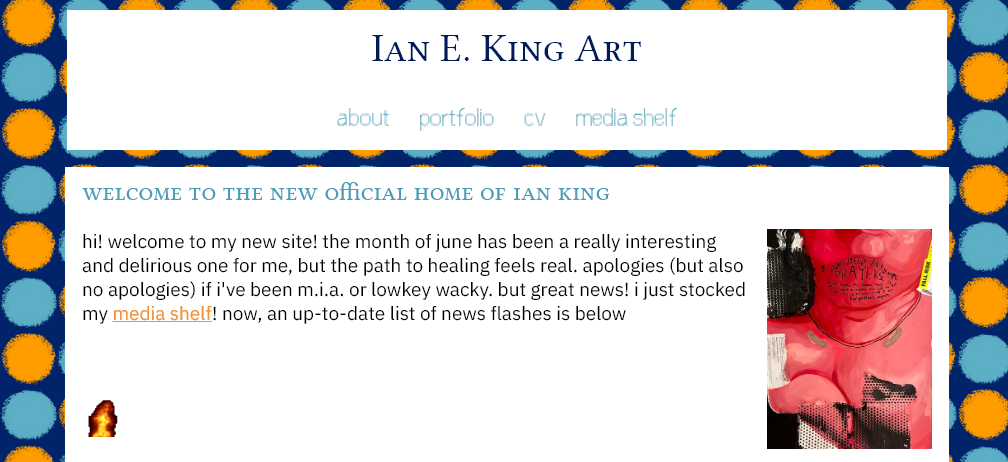
"My name is Ian King and I am a transgender multidisciplinary artist and mutual aid organizer based in Hudson County, NJ. Previously, I built my portfolio on Squarespace, but it never felt like it reflected me or my art: too polished, too corporate, and eventually, too many AI tools. My Cowsite showcases the entire breadth of my work–painting, collage, pen and ink, digital illustration, graphic design, zinemaking, writing and poetry–and allows viewers to expand images easier than any Squarespace gallery I've used. My homepage features any pertinent news flashes I want to highlight, which feels much more organic than competing in the Instagram attention economy or forcing myself to write a Substack post. The following I have on IG is pretty sizeable (and ranges from professional arts practitioners to random gay people), and it is my goal to divert more of that traffic to this webpage as a reminder of what online connection used to be."
amazing!! speaking of portfolios, if you could give one piece of advice to someone creating their first personal/portfolio site, what would it be?
"Updating my previous site always felt like such a chore. If you were a Tumblr kid in middle school like I was, or from the MySpace generation before us, tap into that inner preteen and have the liberty to make it yours! Uniqueness over "professionalism." My site has pixel .gifs and a media shelf where I share what is inspiring me! Who cares if that's "different?""
in a brief convo we had, you mentioned that capitalism is an issue in the art industry, and that generative ai is contributing to this issue. could you briefly explain a little more about this?
"When I first graduated with my BFA degree in 2022, I dove head-first into the gallery world because I was interested in the creative freedom I believed it would bring me. It was fun for about a minute. As it turns out though, the competitive, hyper-capitalist, humiliating culture of this industry would eventually kill my spirit. Arts organizations are insidiously connected to each other, or corporate mega-donors, or genocide-enabling government institutions behind the scenes. You can apply for a grant, but where does that money really come from? Can you really express everything, or do you have to self-censor your art–art, one of the greatest tools of protest!–to make it palatable to a wider audience? There is pressure to promote on the mainstream Internet for anything to even matter, and as a result, your data and handiwork gets scanned and used to train Gen AI models across platforms. I got tired of feeding a machine and aspiring to be the type of artist I was not and did not want to be."
and further, could you explain more about how this affects artists and what you do personally to combat it? can other people get involved?
"As one of the lucky few who has a steady full-time job in my field, I am holding onto it for dear life because the market looks so dire. On scales both grand (corporate design roles disappearing) and small (the dispensary is full of fake art now instead of Rick and Morty murals), AI has eliminated plenty of opportunities for working creatives. I have an open commission policy for any community groups, organizers, small businesses, etc. who need artwork for something they are promoting: you can pay me whatever you can–or, what you think feels fair–for my work. People tend to carry this false assumption that consistent branding must cost a fortune to maintain, but I want to combat that notion and make beautiful stuff accessible to all. If you are an illustrator or designer with a stable income like I am, I implore you to adopt a similar model!"
similarly, what do you think is the most impactful thing a non-artist can do to support human creators right now?
"As I elaborated above, please commission us! Personally, I would rather get haggled lower by a struggling cafe owner than have them generate a menu themself that says shit like "Crœssatn." Also, support your creative friends in ways beyond liking and resharing. You can break yourself out of that cycle too! Recruit other folks and generate foot traffic at their shows. Buy their crafts at fairs. Share their business card with people you meet. Anything you can think of to affirm that their work is a living, tangible thing."
the majority of indie web sites do not measure ‘success’ visually via likes or reposts. have you found that this lack of the modern algorithm makes any difference to how you view your own or others’ creative output?
"Yes, 1000%. Through my personal artistic journey, I have reached the resolution that yes, truly, I can make whatever I want, but I do not have to prove myself to others for validation. Honestly? I have no interest in showing work in a gallery setting any time soon, or measuring my success based on how many exhibitions I get accepted to. I would rather explore the mediums that are most interesting to me in a given moment, make what I can even if it's imperfect, and share it with more grassroots spaces that I know will support me unconditionally. And those spaces are where the real cool stuff is happening. Open your eyes to it and you will find a whole new world of art and ideas."
thank you SO SO SO much for the interview - what a genuinely awesome, inspiring read. is there anything you’d like to share to round off?
"I'm going to use this space to share two examples of music and old web aesthetic intertwining in ways that influenced me in the past year. Firstly, I want to uplift Jersey City's local freeform radio station, WFMU–the oldest station of its kind in the US and entirely funded by listener donations, NOT advertising or underwriting! Seriously, it's commercial-free and the DJs are allowed to say or play whatever they want as long as they don't break FCC guidelines. They have live Internet streaming, an online archive dating back to 2000 (Y2K, the year I was born), customizable playlist pages for each show, a way to mark your favorite tracks with a "clicky-star," and a lively chatroom widget. I've made online friends near and far and broadened my music taste greater than algorithmic streaming ever could. Also, my current favorite musician Todd Rundgren has the most stupidly basic HTML webpage ever and it taught me that you can still sell out medium-size venues and be an icon to your fans even if your site looks like shit and is weird to navigate."
~~~~
a massive thank you again to ian - this was such a genuinely inspiring and interesting read and i appreciate the time you took to share your perspective =]
you can view ian's site at ianeking.cowsite.net. it's a wonderful example of using a cowsite as both a portfolio and personal site!
●══════⋆☆⋆══════●
this has been a rather long issue, so i’ll drop one indie website search tool and let you get on with your day =]
blogroll.org in their own words, are a ’humanly curated list of 1254 fine personal & independent blogs and sites that are updated regularly. no algorithms ever!’
i love having a wee wander through what this site has to offer, and is wonderful for finding sites dedicated to your own personal passions. the first time i used this tool, i found a blog local to me about nature and coffee, and i do in fact love both of those things. i definitely recommend giving it a peep!!!
thanks again for reading, and keep it cool B]
love yous,
the cowsites team <3
